When you're thinking about how customers move through your business, most people talk about "the marketing funnel." It's a familiar term. Awareness, consideration, conversion. Neat, linear, makes sense on a whiteboard.
But here's what I've found after working with dozens of businesses: there's more than one way to map the customer journey. And the model you choose can make a real difference in where you focus your energy and resources.
Let me walk you through four frameworks I use with clients. Each one tells a different story about how customers move from strangers to advocates.
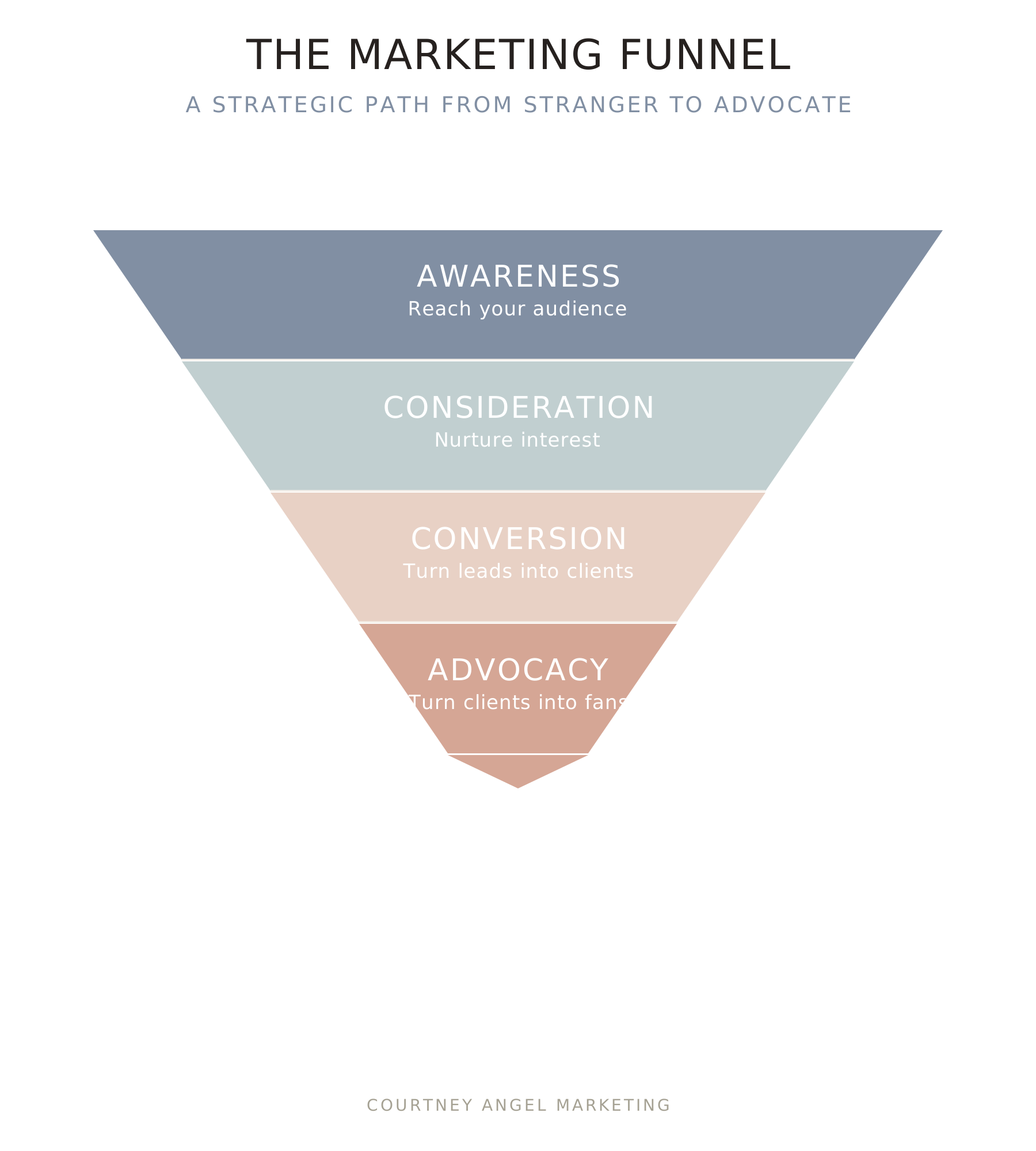
The traditional marketing funnel
This is the one most people know. It's shaped like an actual funnel; wider at the top, narrower at the bottom.
At the top is awareness. Your job here is to reach your target audience and make them aware that your business exists. This might be through content marketing, social media, paid advertising, networking or word of mouth. You're casting a wide net.
In the middle is consideration. People now know you exist, but they're comparing you to alternatives. They're asking themselves: does this business solve my problem? Is it a good fit? Can I trust them? Your job is to nurture this interest and build credibility. This might look like case studies, testimonials, educational content, email nurture sequences or conversations with the sales team.
At the bottom is conversion. This is the sale. The person has decided to work with you and makes a purchase.
Now, there is an additional part to the funnel where people advocate for your business. They are the loyal customers and the end goal.
The funnel model works well for transactional businesses where the relationship typically ends after the sale. If you're selling a product and the customer journey finishes at purchase, this is your framework. It is a good place to start if you have no idea as it is an easy one to wrap your head around.
The flywheel
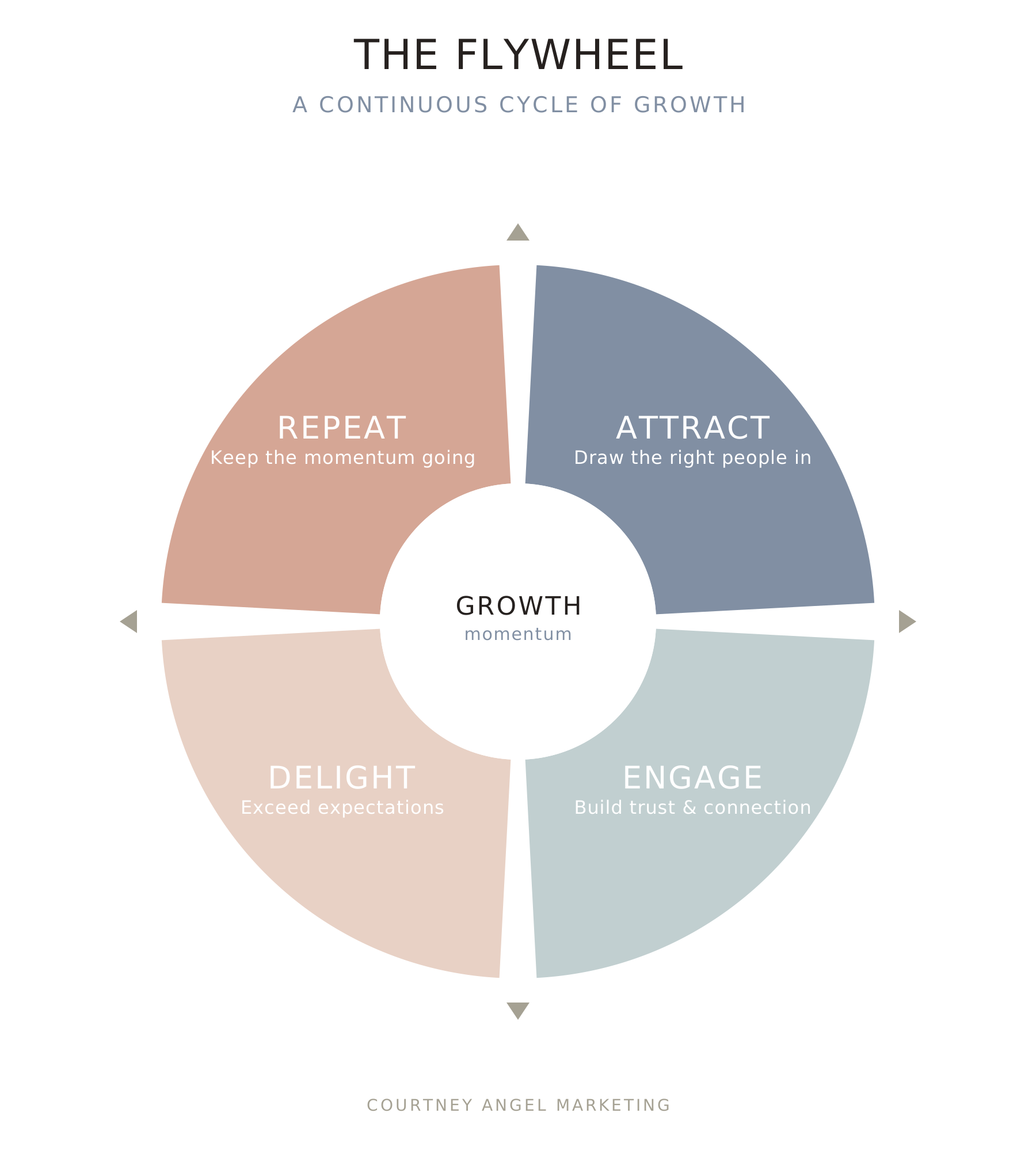
The flywheel model. Instead of a linear funnel, it's circular. And instead of the relationship ending at conversion, it's seen as the start of a growth cycle.
The flywheel has four (well, three plus repeat) stages: attract, engage, delight and repeat.
Attract is about reaching the right people and bringing them into your orbit. Engage is building trust and connection with them. Delight is exceeding expectations and delivering real value. Repeat is about keeping that momentum going so they come back to buy more and refer others.
The beauty of the flywheel is momentum. As each stage runs smoothly, it creates energy that powers the next stage. Delighted customers naturally repeat and refer. Those referrals become new people to attract. The wheel keeps spinning.
The flywheel works brilliantly for businesses where growth comes from customer retention and word of mouth referrals. It's built on the principle that your existing customers are your greatest growth engine.
The bowtie
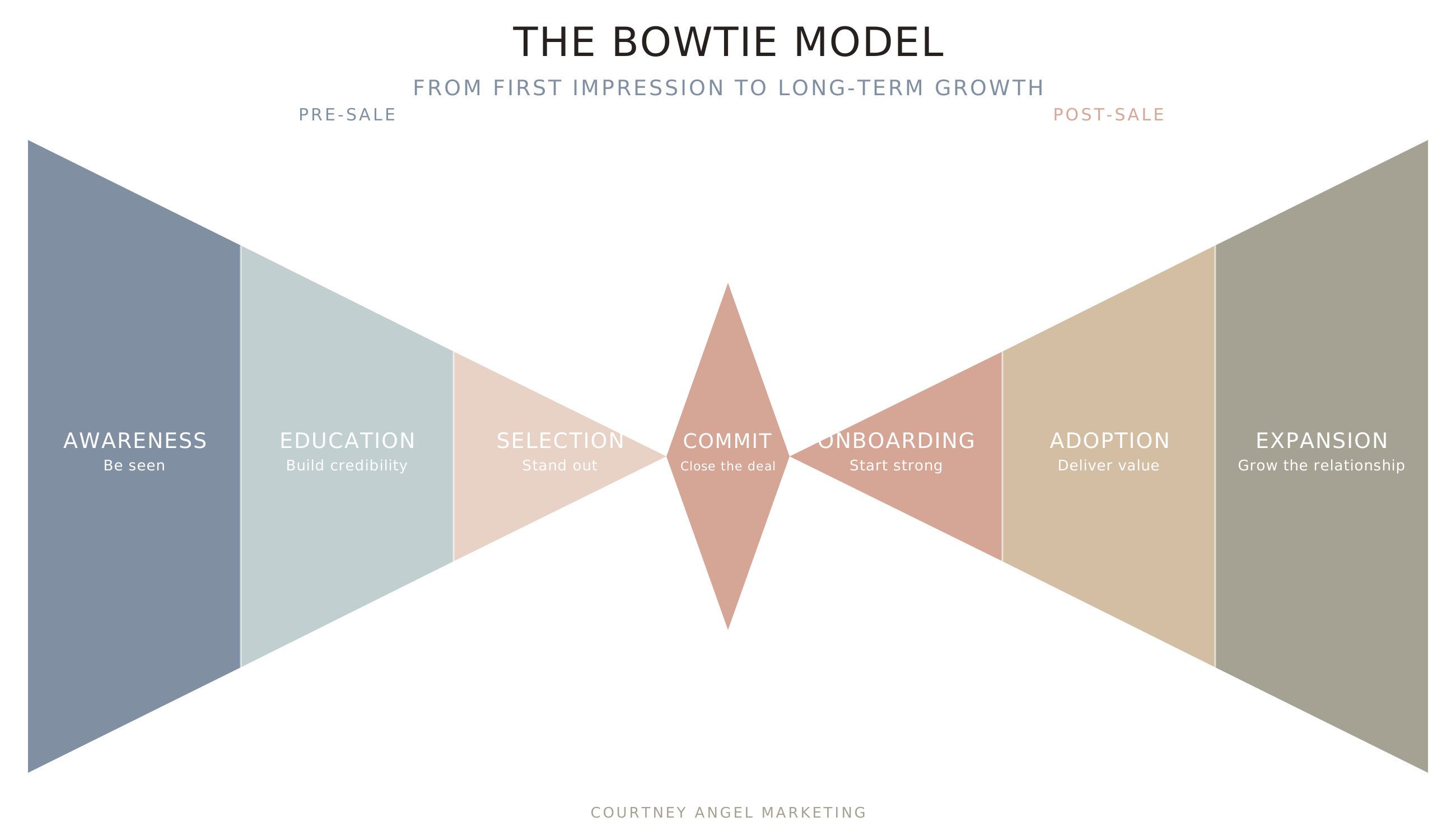
The bowtie model combines elements of both the funnel and the flywheel, but it's specifically designed for service-based software businesses.
It has two halves. The top half is the pre-sale journey: awareness, education, selection and commit. This looks similar to a funnel. You're moving prospects through the decision-making process until they say yes.
But then something different happens. The bottom half is the post-sale journey: onboarding, adoption, expansion and advocacy. The relationship doesn't end at the sale. It evolves.
The bowtie acknowledges a truth that service businesses know well: closing the deal is just the beginning. How you onboard a client, deliver value and nurture the relationship determines whether they stick around, expand their investment with you and refer others.
The CXDNA
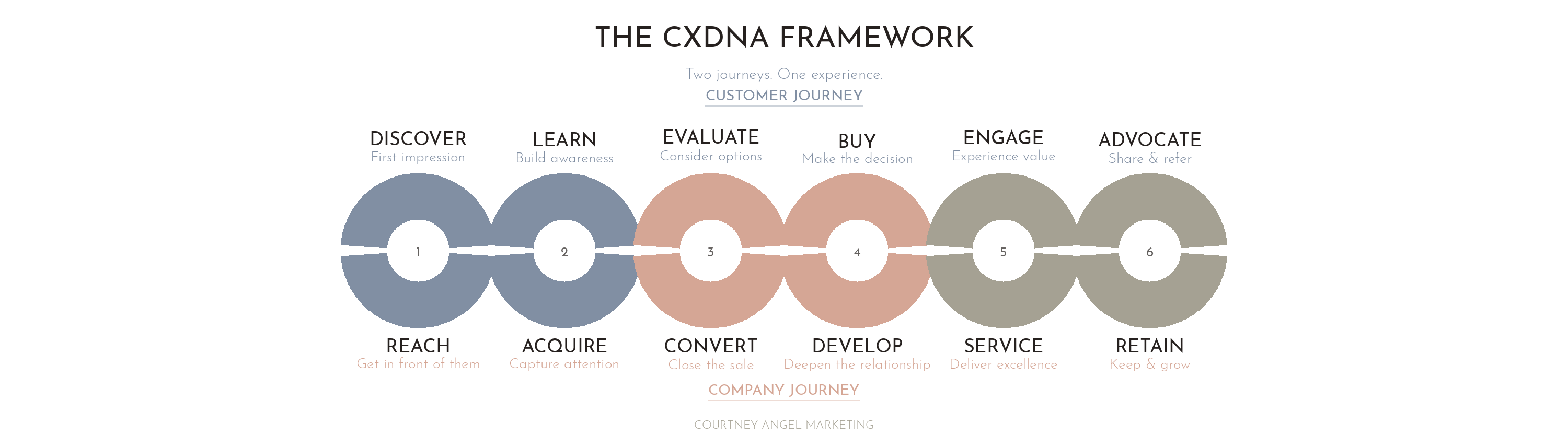
The CXDNA is the most sophisticated of the four models. It stands for customer experience DNA, and it runs two journeys in parallel: the customer's journey and your company's journey. The DNA represents the intertwine of both experiences.
The customer's journey has six stages: discover, learn, evaluate, buy, engage and advocate. These are the touchpoints and decisions a customer makes over time.
But simultaneously, your company is on its own journey: reach, acquire, convert, develop, service and retain. Your job is to make sure both journeys are aligned and optimised.
What makes the CXDNA powerful is that it forces you to think about the experience from both sides. You're not just asking "how do we move customers through the funnel?" You're asking "what are we doing at each stage to deliver value?" and "how does that align with our business capabilities and goals?"
It's more complex to implement, but it's also more comprehensive. It's designed for service businesses with ongoing relationships where customer experience directly impacts retention, upsell and referral.
So which model is right for you?
Here's the truth: the model doesn't matter nearly as much as what you do with it.
Pick a framework that resonates with how your business actually works. Then do the hard work: map your actual tactics and activities into each stage. Match them against your business goals. Then focus your effort on the things that'll move the needle, not just the things that are easiest to do or feel most urgent on any given day.
For transactional businesses, the traditional funnel might be your answer. For growth-focused businesses relying on retention and referral, the flywheel. For service businesses, the bowtie and CXDNA tend to fit better because they acknowledge that the relationship continues after the sale.
Common questions
Which model should I use if I'm a SaaS business?
If you're selling software with an ongoing subscription and regular customer interaction, the bowtie or CXDNA will serve you better than the traditional funnel. The relationship doesn't end at purchase, and how you support and expand that relationship matters.
What if my business doesn't fit neatly into one category?
That's actually more common than you'd think. That's exactly why working through this with a professional can help you build something that fits your reality, not a generic template.
How do I know if the bowtie or CXDNA is right for my business?
Both are built for businesses where you work with clients over time, not just once. If your customers stick around after the initial sale, need ongoing support, or have opportunities to expand their investment with you, you're looking at a long-term relationship. That's when the bowtie and CXDNA become valuable. The traditional funnel and flywheel work better if most of your revenue comes from one-off transactions or new customer acquisition.
How do I start mapping my customer journey if I've never done it before?
Start with the model that matches your business type. Then list out every touchpoint a customer has with you from the moment they first hear about you to after they've been a client for a year. Where do they interact with you? What questions do they ask at each stage? What problems are they trying to solve? Once you've mapped those touchpoints, you can layer in your marketing tactics and activities to see if you're covering all the gaps.
Next steps
If you're not sure which model fits your business, or you've chosen one but aren't sure how to apply it, that's a conversation worth having. Get in touch and we can explore what's right for you.

.png)